Jack It Pull It Up Come Again
Wheel It Upwardly: History of the Rewind
When the DJ stops the music and spins the song back, energy shoots through the oversupply and Jamaican audio echoes across genres
J amaican audio is the heartbeat of modern music. Of the many practices to emerge from sound system culture and accept concur beyond music genres, one remains well-nigh arousing and the most maligned: the rewind.
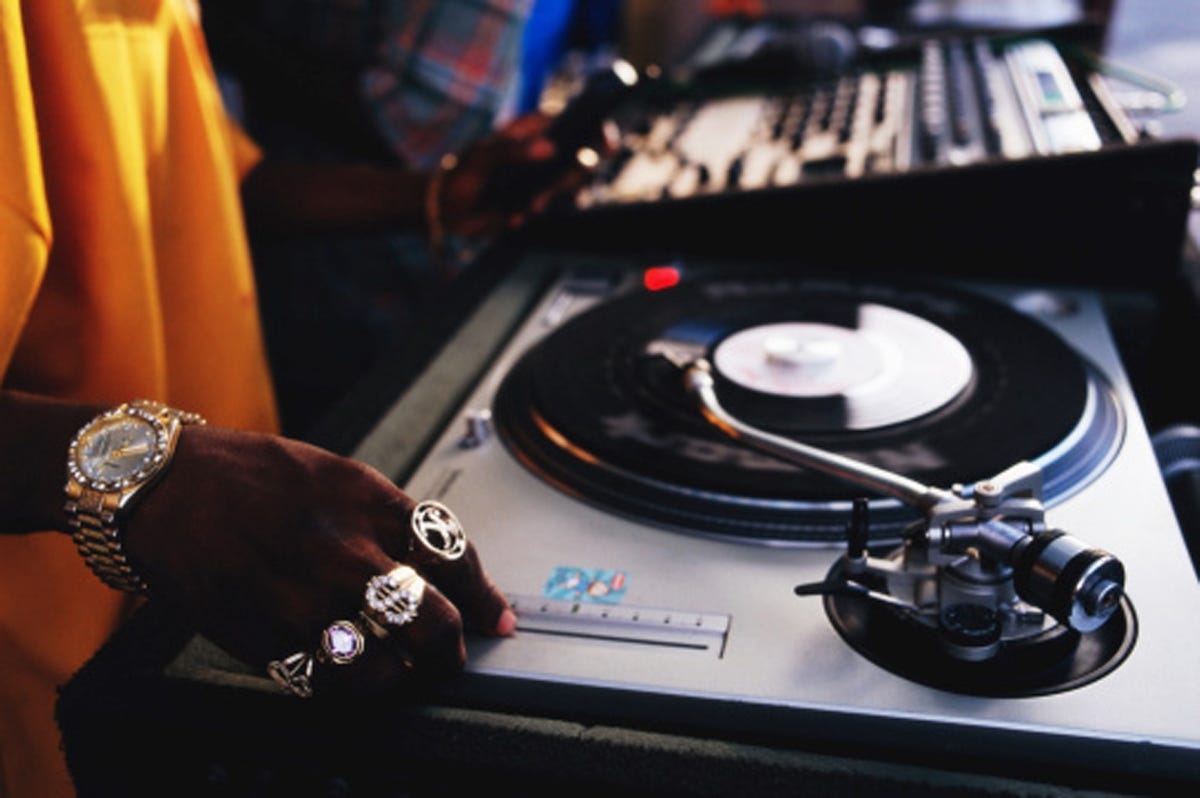
For the uninitiated, the rewind is the act of stopping a vocal—generally playing on a vinyl record or, in more than recent years, on a CD—bringing it dorsum to the showtime, and playing it again. In Jamaica, rewinds are normally performed by selectors in response to oversupply need. You may have heard a hip-hop or trip the light fantastic toe music DJ do the aforementioned thing.
Some rewinds are smooth, the record stopping by utilize of the turntable's start/stop button, while others are a fiddling rougher, the needle hurtling across the vinyl's grooves as a hand aimlessly spins the tape back.
A rewind sounds like this: ►
And information technology looks something like this:

I love rewinds. A good rewind is that rare matter in life: a product of the moment. If the timing is right, a rewind will bring excitement to the dancefloor, a commemoration of the music existence played, an energy charge for the identify and the people.
Unfortunately rewinds are besides subject to abuse, with performers misreading the oversupply, indulging in rewinds for their own satisfaction. As such, rewinds can exist hated too; some observe them obnoxious due to how they interrupt the menstruation of the music or seem to be a mere celebration of the performer's musical ego, an try at trying to faux excitement.
And information technology's not merely fans either, plenty of performers, DJs and critics as well detect rewinds to be borderline. It's this dichotomy that has led the rewind to become ane of the virtually interesting and divisive sound system practices. Yet, despite a growing body of work on Jamaican music, the rewind remains largely untouched by historical thinking. Most critics mention it just as a tool the selector has in his bag for the dance (aka the political party).
I went looking for the roots of the rewind, an attempt to trace its history. Along the way I realized that, after forty years, non but is it nevertheless intrinsic to then much audio arrangement, electronic and dance music performance, it'south too a truly autonomous musical practise. The rewind allows the audience to have a conversation with the performer. It is the groovy equalizer, ensuring the discourse of music does not menstruum only one fashion.
Simply where did the rewind originate? And how did evolve? Let's take it from the top.
Sound Systems: The People'south Radio

It'due south 1968. Kingston, Jamaica. Sound systems have get, as legendary producer Bunny Lee puts it, "the people'south radio station." System operator Ruddy Redwood goes to Treasure Isle studio to cut dubplates. The engineer, Byron Smith, forgets to include the song track on 1. Redwood takes this accidental instrumental to the trip the light fantastic toe. The crowd loses it. One account has him playing information technology for more than 30 minutes straight.
Reggae historian David Katz points to this as a plausible outset for the rewind. For him, information technology starts with "the pop demand factor, because of the shock of something new." This shockwave of the new courses through all of the music styles that sound systems have influenced. And the rewind is never far behind.
Chatting and the MC every bit DJ
In sound system culture, the selector is in charge of the records while the DJ talks. The DJ is the MC. This gives u.s.a. a key inspiration of early rewind culture: DJs sometimes needed to bring the melody back because they had more to say. Haul and pull up.

Enter dub. Herman Mentum Loy told Katz he had the DJ in heed when making his 1973 Aquarius Dub LP. The anthology, he said, would allow DJs to toast continuously without stopping and rewinding the music. Rewinds became so essential to Jamaican dances that alive bands incorporated them. Equally Katz put it, reggae is a studio music, then it'southward non surprising that bands would reflect studio innovations.
As Jamaicans began to migrate to the U.Thou. and America throughout the 1960s and 1970s, the rewind went with them, hidden in the selector's purse of tricks.
An Echo Heard Around the World

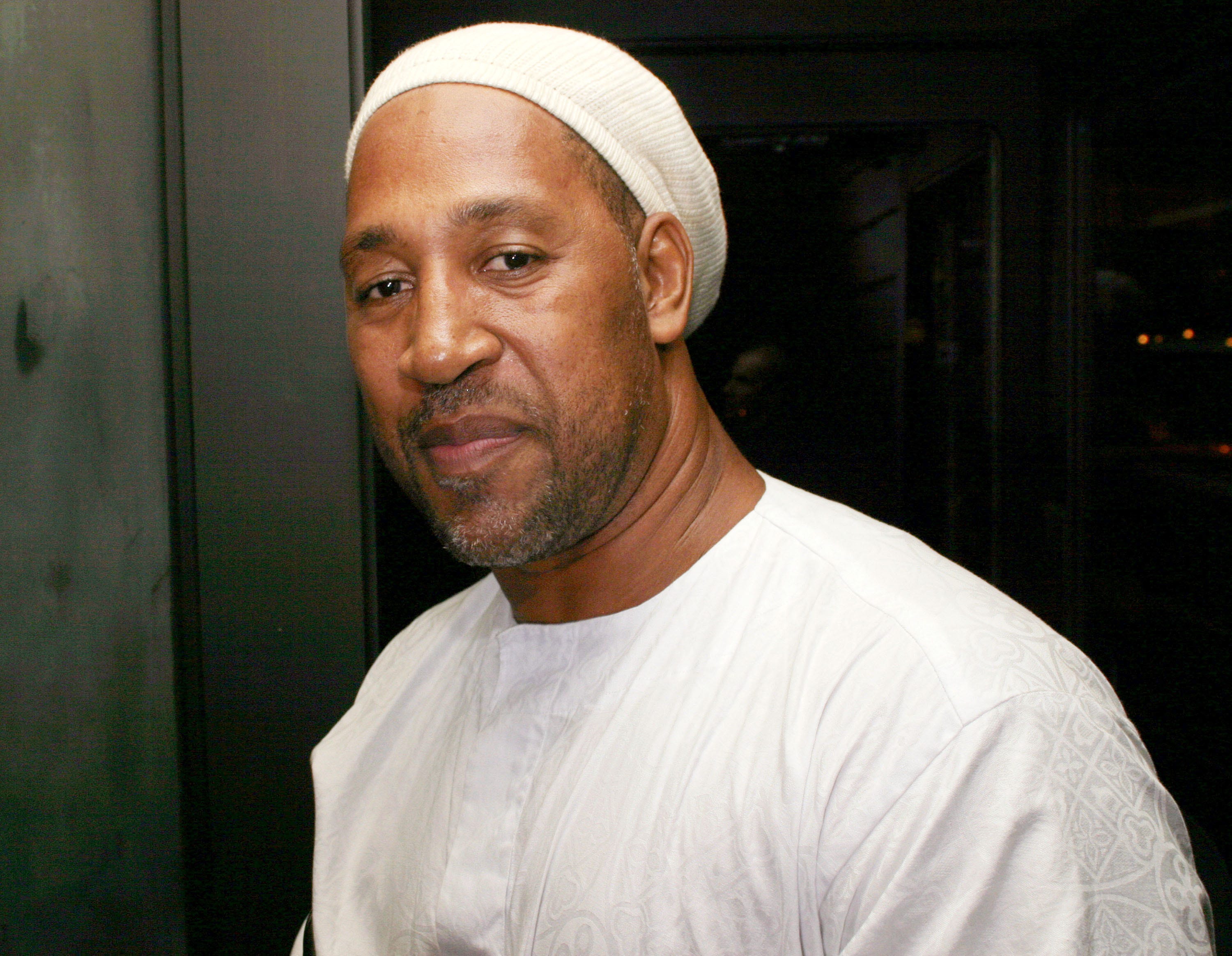
It'due south 1973 in The Bronx, New York. Kool Herc is extending breaks (the funkiest drum parts of records) to keep the dancers moving. He gets on the mic to entertain the crowd. Early hip-hop and sound system culture have much in common.
American kids dug into their parents' record collections for hip-hop's building blocks. British kids did the same with Jamaican music and sound systems to create much of the country's musical innovations.
The U.Chiliad. and America had by and then long been engaged in a game of transatlantic musical ping pong. From the 1970s onwards, the table they played on increasingly began to resemble a sound system.
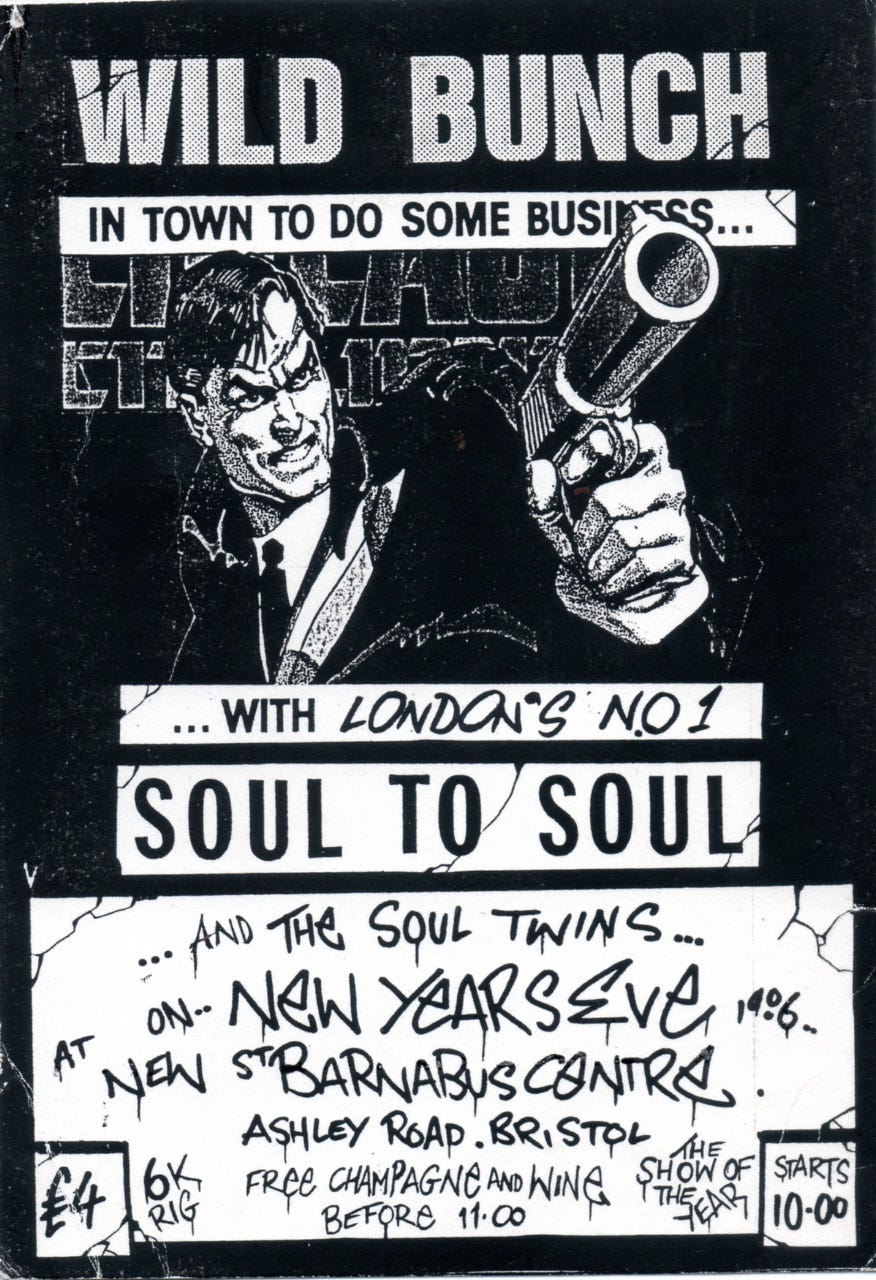
It's 1987 in Due west London. British sound systems Soul 2 Soul and The Wild Bunch (part of which would later on get the group Massive Assail) battle information technology out on New Year'southward Eve, in the same spirit as the audio organisation battles that entertained Jamaicans in Kingston. Like their American hip-hop counterparts, in the infinite of a decade they would go from the streets to the charts.
Someone put the echo on, and it was heard around the world.

Words, Audio and Ability
Actually, let'due south pause the tape for a minute. Words take power, and the rewind has the widest lexicon.
The bulk of it is descriptive: Rewind, haul and pull, pull up that. Physical actions. The turntable is like a cycle, so wheel information technology upwardly rudeboy! Bicycle and come up once more. Wheel and deal it. Rewind in a hurry and the record will spinback. Mechanics. Reload.
Confused? Just take information technology from the summit or from the edge.
Some expressions reverberate the communities' roots. In London, MC Crazy D coined the term jack it in the 2000s. His full postal service-rewind line was "taters on that as nosotros jack it." Rewind inna Cockney rhyming slang stylee.
And I'm just scratching the surface hither.
The most confusing give-and-take for rewind to the uninitiated is forrard. Just as DJs are MCs in Jamaica, a frontwards can hateful a rewind. This refers to the bodily movement in the trip the light fantastic when a song is and then good, the audience moves from backside the speakers to the front. The bodies speak.
Spinning Dorsum on the Wheels of Steel

"Lick forest means rewind, a gunshot ways forrad,
you requested information technology then nosotros rewind" ►
To anyone familiar with early 1990s hip-hop and jungle, the above sentence will ring a bong. It was heard from Funkmaster Flex's DJ sets on Hot 97 in NYC to raves in the U.K. where it preceded the driblet on "Rollidge" by DJ SS.
Its commencement appearance seems to be on the Main Attraction remix of Cutty Ranks' 1991 runway, "The Stopper." Further digging led me to an online mail service stating the vox is that of Joseph Cotton fiber, a famous reggae DJ. Lick wood is Jamaican patois for hitting woods, what you'd do as a sign of excitement in the dance.
Only await, what about forward in that sentence? In this case, the forward likely refers to an bodily forrard, meaning a request to move on to the adjacent track. Seen.
In hip-hop the rewind is rarely used to end and start the runway. Rather it evolved as a fashion to blend from one track to the next, from interruption to progression. This echoes the Jamaican practice of juggling, where selectors quick mix rhythms, playing simply a minute or less of each and sometimes utilise rewinds to progress from one to the other.
Every bit hip-hop grew from the Bronx, the same DJs who came to perfect such mixing basics as blending and scratching would take as well come to hear rewinding every bit a useful tool. Ultimately the rewind in hip-hop would come to take a dual usage: as a mixing trick and equally a sound effect, echoing another Jamaican sonic immigrant, the air horn.
There are traces of the rewind all over hip-hop's get-go decade equally a popular music. It's how Original Concept'due south 1986 "Pump That Bass" starts. It's in betwixt loops of Bob James' infamous cowbell and throughout Mantronix's "King of the Beats," a song with its own peculiar repeat, as we'll hear.
King of the Beats in the Dancehall
Back in Jamaica, dancehall was built-in. A sparser have on reggae, it would accident up the dance in 1985 when King Jammy and Wayne Smith produced the first fully computerized rhythm track, the "Sleng Teng." Recalling the night he dropped the riddim on his rival, Jammy said: "Information technology was like a smash! It was such a new song that the whole place was in uproar — we had to play information technology twenty times more, for all the people bawlin' forrad."
Another shock of the new felt around the globe.
Past the late 1980s, hip-hop began its outset overt infatuation with dancehall and Jamaican music, epitomized by acts such as Shinehead, Special Ed and KRS-One.

In 1992, KRS releases the last Boogie Down Productions anthology, Sex activity & Violence. Its title evocative of non just America'south societal ills but as well dancehall's. The second track is "Duck Down." Towards the terminate of the song, KRS shouts rewiiiiiiiind ► as the bankroll track wheels back. Rewinds go along to reverberate in the lyrics of hip-hop MCs for decades to come.
Hardcore, Yous Know the Score
Back in the U.Chiliad., the late 1980s were a perfect musical storm. (Acid) firm, hip-hop and sound systems collided. The tempo sped up, breaks were added, MCs chatted and the rewind came back. This was hardcore: a manner of music, and a lifestyle.
London producer Wrongtom offers a personal wait dorsum that's aptly concise. "I think the transition from reggae to raves in the U.K. was organic, especially with places like The Four Aces [a legendary east London venue] condign Labyrinth. The transitions from one musical fashion to the next were quick. Pull ups would have continued through."
Information technology's 1988. An unknown London producer by the name of Lennie De Ice writes a song on a six-track admittedly inspired past the "futuristic beats of Mantronix," combining breaks with the "progressive feel of firm music and drum machines." Information technology comes out in 1991 equally "Nosotros Are I.E." Jungle music has its prototype.
The song is a perfect musical summary of the era. It opens with uplifting pads, typical of acid business firm, followed by a rewind, used throughout as a sample. Recollect what I said nearly "Rex of the Beats?"
Original Nuttahs: Telepathy and AWOL
When U.M. hardcore split, jungle was built-in. Hardcore was sped up, archetype breaks were chopped, and dub bass shook the chests. The shock of the new. Jungle embraced rewinds more than than whatsoever other 1990s U.M. sound.
Ane of the earliest jungle parties in London was called Telepathy. Bret, one of the co-founders, told Brian Belle-Fortune, author of All Crews, a book about the history of jungle, that they introduced rewinds to the civilization. "We both come from West Indian backgrounds. We grew upward hither. The reggae flavours nosotros incorporated, things that are manufacture standard similar rewinds—we created that at Marshgate Lane [location for the Telepathy parties in east London]. We said, 'Tell 'em cease the tune. Rewind it.'"
Another key early party was AWOL, held at a venue called the Paradise, where acid house and hardcore mutated into jungle. MC GQ told Belle-Fortune another story about rewind'southward new home. "Randall'southward mixing power was different, on another level. You had a man come running clean from the back of the order, everyone screaming, 'Stop the mix! End the mix! Rewind the whole mix.' I don't care what anyone says. We were the first people to rewind the whole mix."
Shock of the new. Bawl' forward. We pull upwardly two tunes rudeboy.

Signal, Can I Become A Bespeak?
In that location's i more fundamental element in the evolution of rewinds: radio. Or to have it back to Bunny Lee, the people's radio aka pirate radio. In the late 1980s, pirate radio moved off the boats to high rises in the poorer parts of London, only equally sound systems had begun in the ghettos of Kingston.
In London, pirates were essential to trip the light fantastic toe music cultures. Raves were the location, pirate radio was the medium, and music was the message. Ii distinct elements of sound system culture defined pirate radio in the British majuscule: the MC and the rewind.
As jungle became the sound of 1990s London pirate radio, technology allowed the rewind to tag along.
"Calling a radio station seems an odd matter to do," Belle-Fortune remembers. "Merely ringing your favourite pirate to bawl for a rewind is then natural. Nothing establishes a sense of community improve than regular callers." Calling up, and later texting, for a rewind would become integral to the pirate radio experience.
Wot You Call Information technology? Garage?
U.K. garage was built-in during the mid–1990s at a Sunday club chosen Happy Days in south London. It took the eponymous U.S. sound, sped it up, fattened the bass and stripped the diva vocals favoured past U.S. producers for a more instrumental dub approach.
Beingness a London ting, U.G. garage gave a abode to MCs. Announcer and trip the light fantastic music historian Simon Reynolds has argued that the motion of MCs, many from a jungle background, to U.Chiliad. garage helped "Jamaican-ise house music." As always, they entertained and acted as conductor betwixt the DJ and audition when information technology was time to pull upwardly and come again.
In the space of a few years, U.K. garage would evolve into speed garage—faster, harder, stronger—and ultimately 2step, a backlash against the speed and four-to-the-flooring rhythms. 2step was jittery, skipping instead of pounding. It found a natural home on pirate radio.
The importance of rewinds in U.1000. garage, especially 2step, is all-time summarized by a 1999 song from The Aesthetic Dodger and Craig David. In its lyrics, its title and the music itself, the song is a tribute to the rewind. "Re-Rewind (The Crowd Say Bo Selecta)" reached number two in the U.K. charts.
By the turn of the century, the rewind is still there, hidden in plain sight. From Nas' "Blaze a l" to Beverley Knight's self-help guide "Rewind (Find A Way)" via Cylob'due south "Rewind," a bonkers Rewind For Dummies in electronic form.
Back in London, U.Thou. garage continues its unlikely mutation. It moves to the studio every bit producers go seeking another stupor of the new. In comes crud and dubstep, the latest chapter of the rewind's journey from that fateful 1968 night in Jamaica. Even if they may sound nix alike today, the two genres are conjoined twins at nascence.
Grime DJ Elijah points out that rewinds are function of his DNA as a Jamaican youth growing up in London. This is a common story within grime performers and fans that helps explain why the rewind became an essential part of crud'southward furious energy.
I asked Elijah for a stand-out retention of rewinds. "The obvious one is Lethal B's "Prisoner of war" rail in 2004 getting a reload for every verse. It has ten. The tune needed at to the lowest degree ten mins to get through all the singalongs. Certain clubs thought it would be meliorate to ban it."
Similar Existence In Love: You But Know

In the mid 2000s, I would tune in semi-religiously to Rinse FM, London's leading pirate radio. Information technology was the FWD>> show with Kode9, who would run the freshest dubplates from the post–2step era and early days of both crud and dubstep.
We were hundreds of listeners all effectually London. And nosotros but had to do 1 thing to go what we want. "10 gets you a rewind." "I desire to see 10 missed calls." Pirate radio builds its community through its regular listeners.
The early on days of dubstep in London as well gave us i of the most democratic public uses of the rewind in U.Thou. history.
It's 2005 in Brixton, Due south London. A club chosen Third Base of operations, located inside an onetime church building, well-nigh the center of Brixton, began hosting a new bi-monthly party called DMZ. Inside the club the ready was spartan, no flashy lights or smoke machines. Just a finely tuned sound system, numberless of dub plates and bodies in the dance.
The turntables were situated at audience level. As such, anyone could bawl' forward and request or, as happened, stop the tape and telephone call the rewind themselves. Equally with the early days of jungle, the rewind was a way for dubstep audiences to participate in the moment.
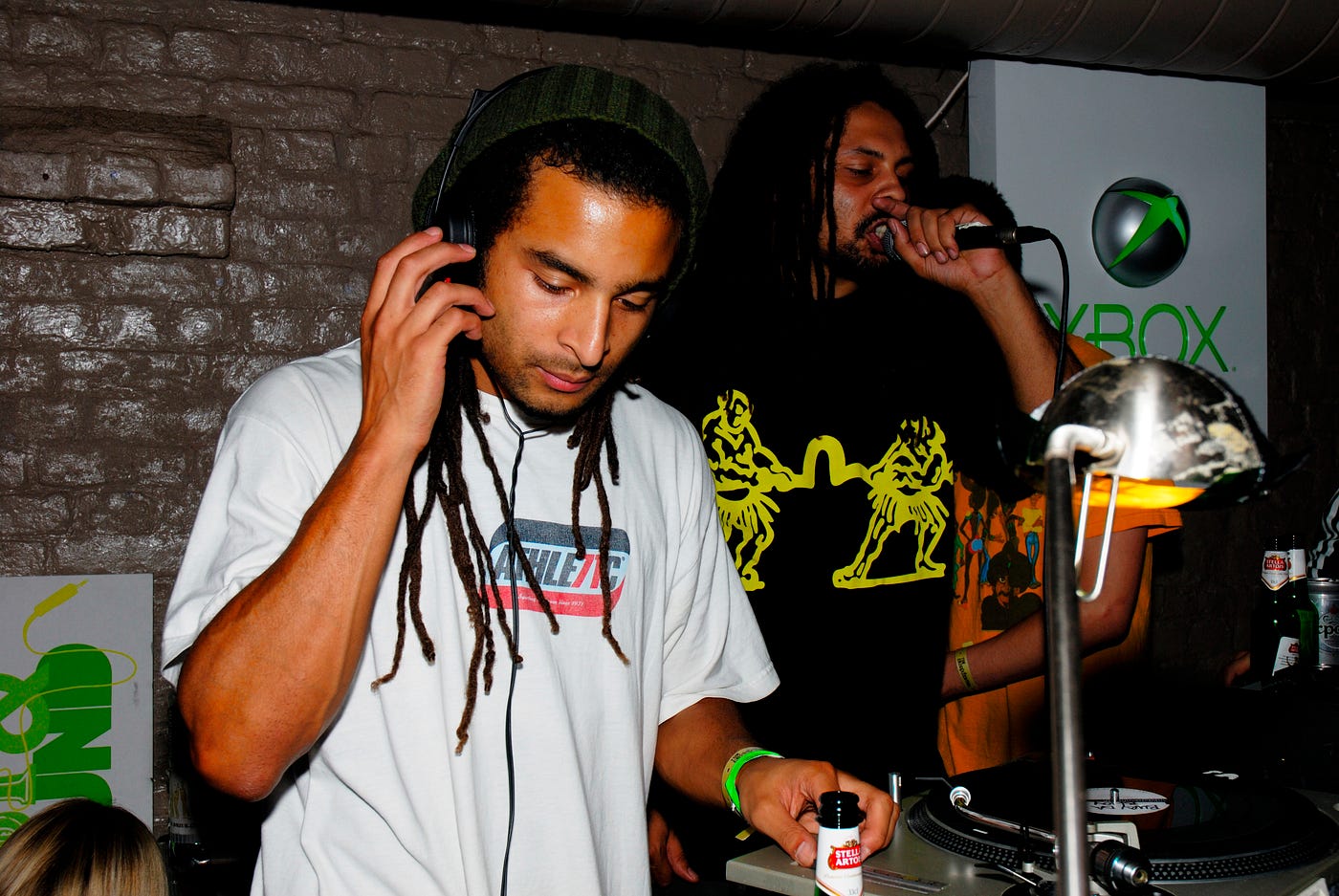
Founded by London producers Digital Mystikz and Loefah, and inspired past sound system civilisation and the heydays of jungle, DMZ was both a spiritual and concrete experience. This was epitomised past its flyers' tagline: "Come up meditate on bass weight."
DMZ inevitably grew by its humble beginnings and moved upstairs to a bigger venue within the same building. The decks were no longer easy to reach but some were lucky enough to nevertheless be in close range to make the call when the time was right.
One of those was Martin Clark. In July 2006, he recounted the importance of such an action. "Rewinding shouldn't be taken lightly… The melody has to be and then unfeasibly amazing that you [cannot] control yourself. There's no decision to cognitively be made, the answer is cocky-axiomatic. Similar being in love: you merely know."
One Final Echo
Two other early attendees of dubstep's foundational years in London were U.Due south. DJs Joe Nice from Baltimore and Dave Q from NYC, who would go on to plant America'southward answer to DMZ, Dub War. At the time, Joe had a radio show called Gourmet Beats, airing online. It soon became the definitive U.Due south. dubstep broadcast.
Sometime betwixt 2005 and 2006, the pair flipped London's pirate radio asking line. "I don't remember what tune I was playing," Joe recalls, "but the chatroom was going crazy, and I said, 'I need 5 for the reload' expecting to see the discussion five times in the chat." Instead, Dave Q went directly for the number. "I just put in a '5' and that was an instant rewind. Information technology became the affair that you but write 'v' if you desire a pull up."
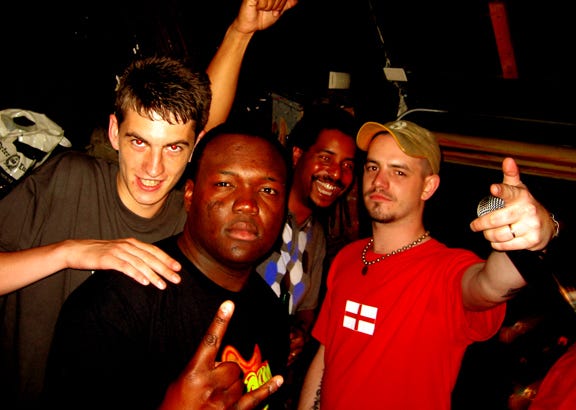
Back in London, it'south DMZ'southward first birthday fustigate. Joe Squeamish is standing backside the turntables with arms outstretched, hands signalling five. The audience reciprocates. The Americans' twist on the standard U.K. radio request makes it back across the Atlantic. I swear I one time saw someone bring a piece of newspaper to DMZ with the number 5 written on it and hold information technology upwards.
No Rewinds Delight, Nosotros're American
It's worth noting at this point that of all the primary dance music genres, business firm and techno are the merely 2—especially in America—to make no use of rewinds equally a performing exercise. Starting with the music's roots in disco all the way to the early warehouse parties, firm and techno are about a continuous experience that led you to spiritual, and sometimes physical, ecstasy. Something as harsh equally the rewind found no place in the music or civilisation.
Thirty years afterward, America is in the thrall of an EDM smash. A new generation of kids seeking new experiences amongst the visual and auditory overloads of stadium-sized shows. In that location are no rewinds.
A Truly Democratic Musical Practice
So after forty years of rewinding tunes, one thing is for certain: the rewind is the nearly autonomous musical practise of mod times: it ensures no one, audience or DJ, is to a higher place anyone else. It besides has a bad rep for being abused, the tool of coked-upward MCs disconnected from the crowd. Sort of like politics today. Like I said, democratic.
Equally unlikely as it is, should the rewind's instrument, the turntable, disappear, we may become unable to bawl' forward. And while I've yet to find a plug-in to automatically generate rewinds in live performance software like Ableton, I know a few modern performers who make it happen on their live rigs.
Elijah imagines the rewind being "like a neat guitar solo or something in stone music." Joe Squeamish sums up the necessary cues for a perfect rewind as "reading the crowd, mood, and timing."
The last word goes to John Eden, who brings information technology back to the people. "The key thing is: sound systems are supposed to exist part of a community… so information technology's a ii-way thing, a conversation rather than a monologue."
If you enjoyed reading this, please click "Recommend" below.
This will help to share the story with others.
Follow Laurent Fintoni on Twitter @laurent_fintoni .
Follow Cuepoint: Twitter | Facebook
Source: https://medium.com/cuepoint/wheel-it-up-history-of-the-rewind-21fdcff243d9
0 Response to "Jack It Pull It Up Come Again"
Publicar un comentario